

Some of the best managers I know have never actually been tested.
They grew up in one organization. Developer first, then tech lead, then engineering manager. Every step felt earned. The performance reviews were stellar. People respected them. Decisions landed without friction. Everything worked.
Until they changed companies.
I’ve watched this pattern unfold with over a dozen managers across my career. And I went through it myself. The experience was brutal enough that I think it deserves a proper breakdown.
How the Trap Gets Built
The typical path looks like this. You join a company as a developer. You’re above average - not because you’re smarter than everyone, but because you understand the technology well and you take time to learn the business domain deeply. That combination is rare and it makes you incredibly effective.
When you suggest an architecture decision, people listen. When you flag a risk, they trust you. You become a catalyst on the team - the person others look to when things get complicated.
If you also have charisma and a natural drive to solve problems, the promotion comes fast. Tech lead first, then manager. The reviews keep coming back with “exceeds expectations” across the board.
Here’s what nobody tells you: most of your success at this point comes from context, not from management skill.
You know the codebase inside out. You know the domain. You know the people and their history. You know which shortcuts are acceptable and which technical debt is actually dangerous. You’ve built trust and credibility over years.
That trust acts as a shortcut for everything a manager normally needs to do the hard way. You don’t need to influence people - they already follow you. You don’t need decision-making frameworks - everyone accepts your judgment. You don’t need to motivate anyone - your track record does that for you.
The trap is invisible because everything works.
What Happens When You Switch
The wall hits fast. I remember my first weeks at a new company as a manager, and the contrast was shocking.
In my previous company, I’d suggest a technical direction and the team would run with it. At the new place, two strong seniors immediately challenged my approach. Not because it was wrong - because they had no reason to trust my judgment yet. They didn’t know my track record. They hadn’t seen me be right fifteen times before.
Suddenly, things that used to take me five minutes took weeks. Motivating people became a real problem - something I’d never even thought about before. Giving feedback that actually landed? Completely different game when people don’t already respect you.
I went from “exceeds expectations” to struggling with basics.
You’ve probably heard of the Peter Principle - the idea that people get promoted until they reach their level of incompetence. What I’m describing is sneakier. You look competent at your level. Your reviews confirm it. Your team confirms it. But the competence is local, not portable. You haven’t reached your ceiling - you just haven’t left the room where the ceiling is invisible.
And this is the part that really messes with your head. You start questioning whether you were ever actually good, or whether you were just riding context and reputation. The confidence drops. The frustration builds. You give feedback, people push back. You try harder, the resistance grows. It’s a cycle that can spiral for months.
Why “1 Year Repeated 5 Times” Is Real
There’s a phrase I keep coming back to: staying in one company for five years doesn’t give you five years of experience. It gives you one year repeated five times.
That’s harsh, and it’s not always true. If you have a great mentor who pushes you out of your comfort zone, you can grow significantly in one place. But the default path - without that intentional pressure - is stagnation disguised as stability.
When you stay in the company where you grew up, the environment doesn’t force you to develop general management skills. You never need to build trust from scratch. You never need to influence people who don’t already know you. You never need to make a decision and defend it without the weight of your reputation backing you up.
I’m talking about specific things. How to run a structured decision-making process when nobody in the room trusts your gut. How to give feedback that lands with someone who’s known you for two weeks, not two years. How to handle stress and pressure when you can’t just lean on familiar people. How to read a new organizational culture fast enough to avoid stepping on political landmines. How to motivate a team that didn’t choose you and doesn’t owe you anything.
These are the skills that make you a manager anywhere. Without them, you’re a manager of one company.
Think about it this way. A manager who has worked in three different companies over eight years has had to build credibility from zero three times. They’ve had to read three different organizational cultures. They’ve dealt with three different sets of strong personalities who didn’t owe them any trust.
That person is battle-tested. The one-company manager is not.
The Confidence Chart Nobody Talks About
If I had to draw my own competence trajectory as a manager, it would look something like this:
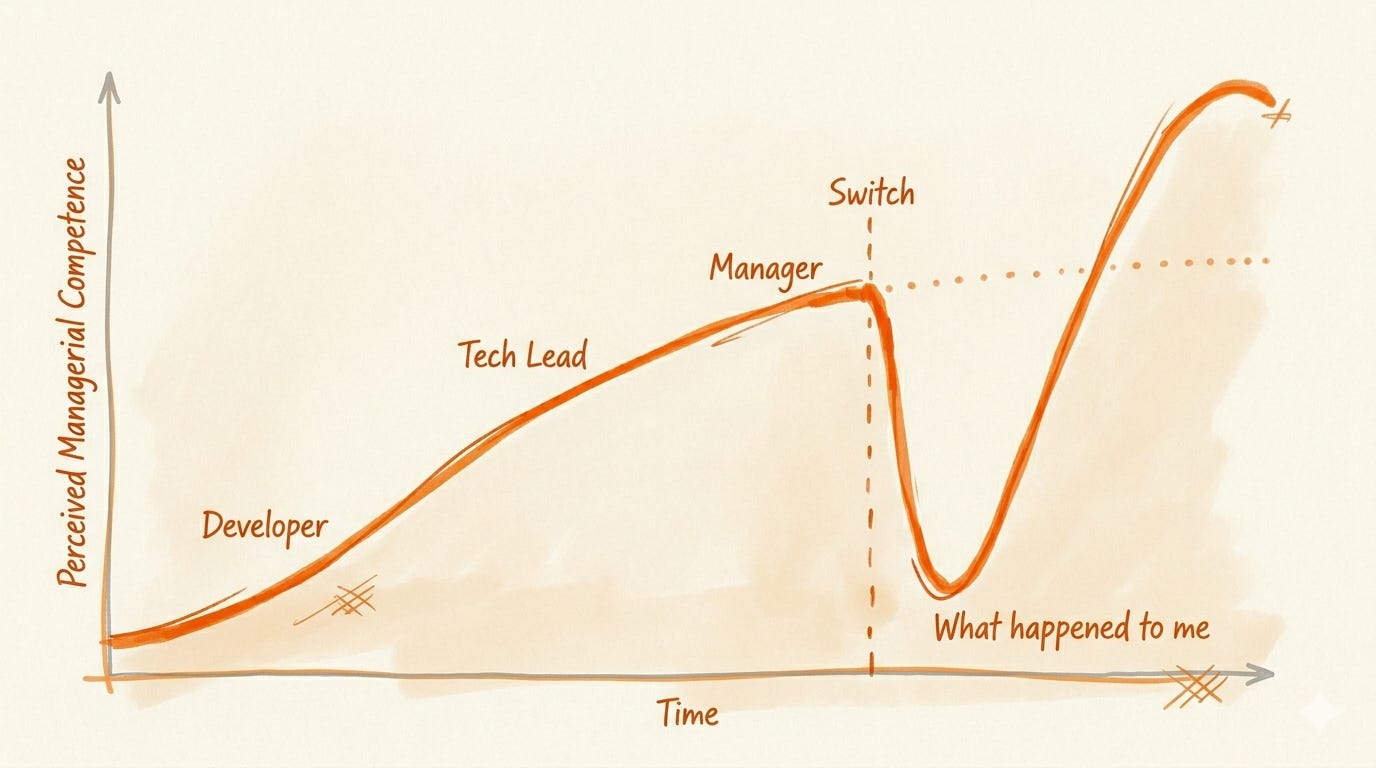
During my years at the first company, the line went steadily up. Developer, tech lead, manager - every step felt like confirmation that I was getting better. The slope was steep and the direction was clear.
Then I switched companies. The line dropped off a cliff. Suddenly I felt like a junior again. Things I thought were automatic skills turned out to be situational advantages. That drop lasted months, and the recovery took ~2 years to get to the same level at the new company.
But here’s the thing. The recovery line eventually goes higher than the original trajectory ever would have. Because now the competence is real. It’s not built on domain knowledge and reputation. It’s built on actual management skills that work regardless of context.
The short-term pain of switching companies is the price of long-term transferable competence.
The Uncomfortable Advice
I know this might be unpopular, and I know companies won’t love hearing it. But if you’re being selfish about your career - and I think you should be - here’s what I’d say:
If you grew up in one company and became a manager there, consider changing jobs after one or two years in the management role. Not because the company is bad. Not because you’re not learning anything. But because the company where you grew up will almost never push you out of your comfort zone hard enough.
You need the shock of starting from zero. You need to walk into a room where nobody cares about your previous track record. You need to feel the friction of building trust without shortcuts.
That friction is where the growth happens.
I’m not advocating for job-hopping every six months. That’s a different problem. And I acknowledge that some managers do find enough challenge in one organization - through a great mentor, through a massive reorg, through taking over a struggling team.
But those are exceptions. The default path in a comfortable, familiar company is to keep doing what already works and never develop the muscles you’ll need when it stops working.
Where I Am Now
That first company switch was the hardest. Each one after got less painful - not because it got easier, but because I was carrying skills that actually transferred between contexts.
If you recognize yourself in this article - if you’re a manager who’s only ever worked at one company and everything feels smooth - ask yourself: is it smooth because you’re great, or because the environment makes it easy?
And if you’ve already made the switch and you’re in that dip right now - feeling like you forgot how to do the job you were great at - I want you to know something. That feeling is normal. It’s not a sign that you were a fraud. It’s a sign that you’re finally being tested for real.
The managers who go through this and come out the other side don’t just recover. They become anti-fragile. They stop depending on any single environment to feel competent. They become the kind of leader who can walk into any team, any company, any mess - and operate.
That dip on the chart is temporary. What you build inside it is permanent.
The pattern you're describing has a mechanism worth naming. The one-company manager has become the routing infrastructure for the entire system. Every decision, every context handoff, every coordination act flows through them because the system was never built to handle it any other way. Their competence is precisely what made the structural gaps invisible. Nobody felt the pain, so nobody fixed the plumbing.
Switching companies reveals this. It doesn't necessarily fix it. If the operating pattern is "I absorb whatever the system can't handle," the manager rebuilds the same architecture at the new company. Eighteen months in, everything routes through them again, the competence feeling returns, and the cycle restarts. Different codebase, same star topology.
The portable skill worth testing for: can you build a system that continues operating when you subtract yourself from it? Most managers ask "can I build trust from zero?" The sharper question: "what happens to my team when I'm gone for a month?"