
Why remote teams start slower but win long-term
Remote vs Local Teams: Why Remote Teams Start Slower But Win Long-Term

I’ve managed both local and remote teams for years. Sometimes hybrid, sometimes fully distributed across offices in different countries.
Here’s what I’ve consistently observed: local teams sprint faster at the start. Remote teams build something more durable.
This isn’t a “remote is better” post. Both setups have real tradeoffs. But most people draw conclusions way too early - they see a remote team struggle in week two and decide it “doesn’t work.” Meanwhile, local teams coast on easy verbal communication until the project reaches a size where that same communication becomes the biggest source of chaos.
Let me break this down.
📋 In this article:
🏢 Why local teams feel productive but accumulate hidden debt
🌍 Why remote teams start slow but scale better
🧠 The tribal knowledge trap that kills onboarding
📊 How productivity actually shifts over a project’s lifetime
⚖️ What hybrid teams get wrong (and right)
🏢 The Local Team Advantage (And Its Hidden Cost)
A fresh local team hits the ground running. This is real, not a myth.
When you sit next to someone, communication is effortless. You turn around, ask a question, get an answer. No scheduling a call, no typing a message, no waiting for a response. Problems get resolved in five minutes that might take thirty over Slack.
But here’s what nobody talks about: every verbally solved problem creates tribal knowledge.
Tribal knowledge is information that lives exclusively in the heads of people who were in the room. It’s not documented. It’s not searchable. It’s not transferable.
A few examples I’ve seen firsthand:
“Don’t use script XYZ in the dev environment - it behaves differently from production for reasons nobody remembers.”
“If user.id equals 4217, the system routes the request differently. Dave set this up during the migration two years ago.”
You probably know a few yourself. These things pile up. Every quick hallway decision, every “let’s just fix it and move on” moment - they all create invisible dependencies on the people who happened to be present.
The local team trades speed for knowledge fragmentation. And you don’t feel the cost until someone new joins.
🧠 Why Onboarding Into a Local Team Is Secretly Brutal
When a new developer joins a well-established local team, the first few weeks are rough.
Not because the codebase is complex - that’s expected. But because dozens of small decisions, workarounds, and unwritten rules live only in verbal history. The new person bumps into something counterintuitive, asks about it, and the answer is always the same: “Oh yeah, we decided that in a meeting back in March. There’s no documentation, but basically…”
Then they reiterate the full history. Again.
I have an observation - and I’ll admit it might not be universally true, but it’s been consistent in my experience: people who prefer office work tend to write fewer notes. Solving things verbally feels faster, so writing it down feels like overhead. Like you’re “undermining the point” of being co-located.
But it’s not overhead. It’s an investment that compounds. And skipping it means every new hire pays a time tax that the original team never notices because they already carry the context in their heads.
🌍 Remote Teams Build Slower - Then Accelerate
The beginning of a remote team collaboration is genuinely harder.
You can’t lean over and clarify something in ten seconds. Written communication takes more effort than verbal. Building team cohesion requires deliberate work. All of this is true.
But adopting a written-first approach has a compounding advantage: everything leaves a trail.
You’ve probably seen this forum pattern:
“Does anyone know how to do XYZ?” - “Use this link: [dead link]” - “Nevermind, I figured it out.” (without explaining how)
This happens constantly in local teams. Problems get solved, but the solution evaporates.
In a remote team using chat, the solution is right there in the conversation history. Copy the relevant thread into a knowledge base, tag it properly, and suddenly you have searchable institutional knowledge that any new hire can access on day one.
Remote teams are forced to document by default. Not because they’re more disciplined - because the communication medium itself produces artifacts. Chat logs, written decisions, shared documents. The overhead is real at the start, but it becomes an accelerator.
I’ve seen remote teams onboard new developers in half the time compared to local teams on the same project. Not because the remote team was “better” - because the knowledge was accessible.
📊 The Productivity Crossover
Here’s what the productivity curve actually looks like for newly formed teams:
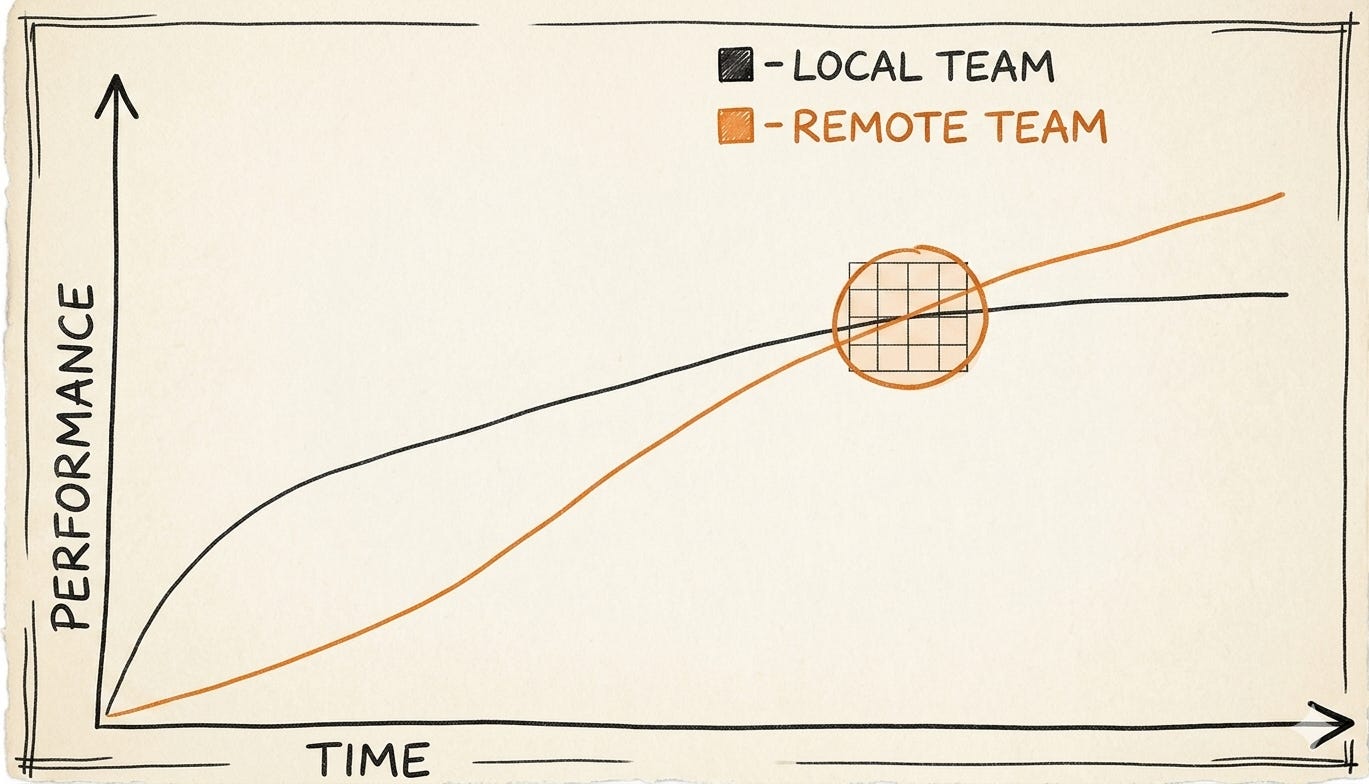
Local team: Fast ramp-up. High initial velocity. But productivity plateaus - and often declines as the project grows, complexity increases, and tribal knowledge becomes a bottleneck.
Remote team: Slower start. More friction in the first few weeks. But productivity keeps climbing because the knowledge infrastructure scales with the project.
The crossover happens somewhere between week 8 and week 16, depending on team size and project complexity. After that point, the remote team has a structural advantage that only grows.
Team size matters here. Small teams (3-4 people) can sustain the local advantage longer because tribal knowledge stays manageable. The larger the team, the earlier the crossover happens.
⚖️ What I’ve Learned From Hybrid Teams
Most of my recent teams have been hybrid - some people in the office, others remote. This combination reveals the dynamic in a very raw way.
Here’s my consistent observation, and friends who manage similar setups confirm it: it’s always the remote team waiting for the local team to be ready for a call. Not the other way around.
Calls start 5, 10, sometimes 15 minutes late because someone on the local side is at lunch, in another conversation, or just didn’t notice the calendar notification. The remote team is already sitting in the call, waiting.
Another pattern: local teams are harder to reach on chat. They deprioritize written messages because there’s so much happening verbally in the office. Someone pings a question on Slack, and the local team responds hours later - if at all. They’re not ignoring you on purpose. They’re just swimming in a different communication medium.
This creates a real friction point in hybrid setups. The remote part of the team operates with higher written discipline. The local part operates with verbal shortcuts. Neither is wrong, but the mismatch causes delays and misunderstandings.
The Atmosphere Question
One area where local teams genuinely have an edge: team spirit.
Casual conversations. Spontaneous jokes. The small human moments that happen naturally when you share physical space. These things build connection in a way that Slack channels simply can’t replicate.
Remote teams need to manufacture these moments deliberately. Occasional team gatherings, virtual coffee chats, off-topic channels. It works, but it requires conscious effort.
If you’re building a remote team, don’t skip this. The work gets done either way, but people who feel connected to their teammates produce better work and stay longer.
The Bottom Line
Local teams and remote teams each have real strengths. The mistake is evaluating remote teams by their first two weeks and local teams by their best month.
Local teams win on speed and atmosphere. Easy communication. Natural bonding. Quick problem-solving. But they accumulate knowledge debt that compounds over time, and that debt shows up as painful onboarding, repeated explanations, and a growing dependency on specific people’s memory.
Remote teams win on scalability and knowledge durability. Everything is written. Everything is searchable. Onboarding gets faster, not harder, as the project grows. But the start is slower, team spirit requires active investment, and you need people who are actually equipped for remote work - both in terms of mindset and environment.
The ideal? Good project management that makes you forget whether someone is local or remote. Same access to information, same communication standards, same expectations.
That’s hard to achieve. But knowing where each team type breaks down is the first step to actually getting there.
Great analysis! I’ve never stopped to consider “people who prefer office work tend to write fewer notes.” What an astute observation.
I’ve always maintained that allowing a team to decide at the team level what works best is where you will see the highest level of engagement. There’s an agency component of allowing someone to decide that impacts how they show up.
Genuinely enjoyed this breakdown from a technical team perspective.
Thanks for this. It reminds me of my time at Trustpilot when we all went remote during the pandemic and also opened a new location. In the first few weeks slack was silent and progress was slow as most collaboration rituals and decisions were previously in person. We introduced the RFC and eventually found the “remote” rituals that were keeping and sharing context and then the teams were flying.